
The Beatles did say that life is what happens to you when you’re busy making other plans. Alas, my idea of writing a journal piece for every month hasn’t quite worked out since, fortunately, I’ve been busy giving tours and preparing some more.
October has also been unusually warm, feeling more like summer than autumn, apart from the chillier nights and early mornings. It has made me wonder whether my advice on autumn travel in Lisbon was a little out of step with what we’ve all been experiencing.
I’m expecting November to bring some true autumn vibes now, although you won’t hear me complaining about the end of reliably good weather, sunny walks and the possibility of ocean swims well into October.
With that short disclaimer, let’s move on to what you can expect from November in Lisbon.
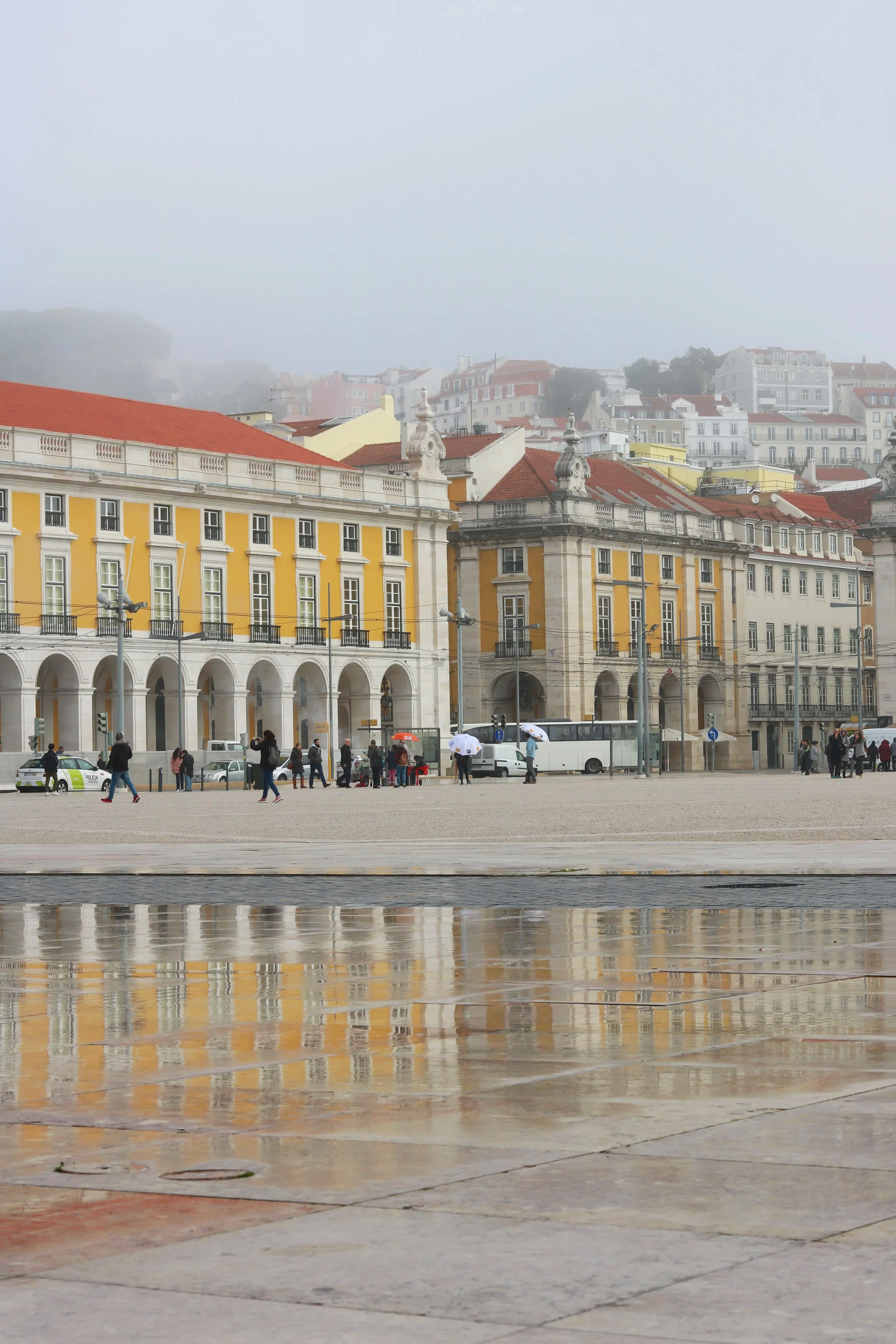
Moody Lisbon on a rainy day
The weather: what to expect
Let’s start with the basics: the weather. Like it or not, if we ignore the weather and aren’t prepared for its nuances, we risk not having the best possible experience.
November can be moody. You may be treated to sunny days, but you should also expect rain. And the thing about Lisbon and rain is that, while showers can come and go, if an Atlantic weather front moves in, you may get considerably more rain than you bargained for.
Nothing too dramatic, necessarily, but enough to make walking along the cobblestones a less pleasant and considerably sleepier experience.
But fear not! With a little planning, November can turn out to be one of the best months to visit the city.
For years, October and May were regularly singled out as the best months to visit Lisbon: shoulder seasons, fewer crowds and lovely weather. Well, all that advertising has worked its magic, and both months have become some of the busiest of the year. From my experience, October can be busier than September.
Enter November. You may be taking a bigger gamble with the weather, but you will definitely benefit from fewer crowds. And there is still plenty going on, particularly when it comes to art, music and culture. I’ve put together a curated list of events at the end of this article.
Making the most of shorter days
The other thing to bear in mind is that the days are getting shorter. With the end of daylight saving time, the sun will be dipping towards the horizon well before you’ve finished exploring all of Lisbon’s hills.
However, with a little planning, you can still make the most of your days.
My first piece of advice for November is to plan your main sightseeing and city walks for the morning. You can simply let your mood and natural curiosity guide you, of course, or you can plan a guided tour. And, naturally, I’m biased, so I’ll leave you a link right here to explore [one of my own tours — insert your tour link].
If you focus your walking on the morning and early afternoon, finishing around 4 or 5 pm, you’ll have time to relax in a lovely café or return to your accommodation before heading out to explore Lisbon’s gastronomic scene. Just remember to bring an extra cardigan or coat: the temperature difference between a sunny November afternoon and the evening can be considerable.
What to do when it rains
If you happen to encounter a few showers during your stay, my advice is to keep a list of smaller museums and heritage sights that you can visit during a downpour.
I’ve put together a list of my personal favourites, organised by neighbourhood, below. That way, if you’re exploring a particular area and suddenly need shelter, you’ll have the perfect excuse to discover somewhere unexpected and satisfy your cultural curiosity at the same time.
On the other hand, if you’re visiting Lisbon and the forecast calls for continuous rain, I’d plan my days around larger museums and heritage sites where you can spend several hours sheltered from the elements while discovering some of the city’s cultural treasures.
I’ve included a second list for that, too.
My favourite small museums and heritage sights, by neighbourhood
Keep this list handy if you’re caught in a downpour. Some of these places are compact enough for a spontaneous visit, while others offer guided tours or enough to explore to fill a good part of an afternoon. Check opening hours and booking requirements before setting off.
Baixa
Museu do Dinheiro — Housed in the former Church of São Julião, this museum explores the history of money through an engaging mix of historical objects and interactive displays. An unexpectedly interesting stop in the heart of the city.
MUDE — Museum of Design — Dedicated to design and fashion, MUDE explores how everyday objects, furniture, clothing and visual culture reflect changing societies. Check which galleries and exhibitions are open during your visit.
Núcleo Arqueológico da Rua dos Correeiros — Hidden beneath a modern building, this archaeological site reveals layers of Lisbon’s history, from Roman occupation to later periods. A fascinating reminder of how much of the city lies beneath our feet. Advance booking is required.
Rossio / Restauradores
Geographical Society of Lisbon — Visit its remarkable Portuguese Exploration and Discovery Museum, with historic maps, ethnographic collections and objects linked to Portugal’s overseas expeditions. A wonderfully old-fashioned institution with a fascinating collection.
Casa do Alentejo — More than a cultural association, this former palace is a hidden architectural gem, with richly decorated rooms, an impressive Moorish-inspired courtyard and a restaurant serving food from the Alentejo region.
Alfama / Sé
Lisbon Cathedral (Sé) — One of Lisbon’s oldest and most historically significant religious buildings, combining Romanesque origins with later Gothic and Baroque additions. Its interior offers a welcome pause from the surrounding streets.
Roman Theatre Museum — Discover the remains of a Roman theatre built into the hillside below the castle. The small museum helps explain the Roman city of Olisipo and the archaeological discoveries made in this part of Lisbon.
Decorative Arts Museum — Museu de Artes Decorativas Portuguesas — Housed in the Azurara Palace, this collection offers a glimpse into Portuguese aristocratic interiors, furniture, textiles, ceramics and decorative arts. Go for the atmosphere as much as the objects.
Military Museum — A large historical collection covering Portuguese military history, with weapons, uniforms, paintings and monumental decorative rooms. Particularly interesting for the building and its historical displays.
National Pantheon — Housed in the monumental Church of Santa Engrácia, the Pantheon commemorates important Portuguese figures. The interior is impressive, but the terrace views over the Tagus are an added reason to visit.
Monastery of São Vicente de Fora — One of Lisbon’s most rewarding historical monuments, with monumental architecture, remarkable azulejo panels and the pantheon of the Braganza dynasty. Allow time to explore its different spaces.
Belém
National Coach Museum — An extraordinary collection of royal carriages and ceremonial vehicles that offers a glimpse into the spectacle and pageantry of the Portuguese court. The collection is impressive even if you have little interest in transport.
Jerónimos Monastery cloisters — A masterpiece of Portuguese Manueline architecture, with elaborate stonework, maritime motifs and a remarkable sense of scale. The cloisters alone are worth making time for.
MACAM — Museum of Contemporary Art Armando Martins — A contemporary art museum combining a private collection with a hotel and cultural programme. Worth visiting for its collection, temporary exhibitions and the unusual setting.
MAAT — Museum of Art, Architecture and Technology — A striking riverside museum exploring the intersection of contemporary art, architecture, technology and society. Even when the exhibitions aren’t your main interest, the building and its relationship with the river make it worth a stop.
Bairro Alto
Convent of Cardaes — A remarkable convent interior filled with Portuguese azulejos, gilded woodwork and paintings. It is particularly special because it remains connected to a living religious and charitable institution. Visits are guided and take place at specific times, so check the schedule in advance.
Church and Museum of São Roque — The church is surprisingly restrained on the outside but richly decorated within, while the museum holds an exceptional collection of religious art and sacred objects.
Geological Museum — A wonderfully traditional museum of minerals, fossils and geological specimens. Its old-fashioned displays are part of its charm, and it offers a very different perspective on Portugal’s natural history.
Avenidas Novas
Casa-Museu Dr. Anastácio Gonçalves — A former private residence with a collection spanning Portuguese painting, furniture, ceramics and Chinese porcelain. It offers an intimate look at early twentieth-century collecting and domestic interiors.
Avenida da Liberdade
Casa-Museu Medeiros e Almeida — A private collection displayed in a former residence, bringing together European decorative arts, clocks, jewellery, paintings, furniture and Chinese porcelain. A particularly good choice if you enjoy the detail and craftsmanship of historic interiors.
Chiado
Museu Nacional de Arte Contemporânea — Museu do Chiado — Dedicated to Portuguese art from the nineteenth century onwards, the museum is a useful introduction to the development of modern and contemporary art in Portugal.
Basilica dos Mártires — One of Chiado’s historic churches, with a richly decorated interior and a long connection to the history of Lisbon. A quiet cultural stop between shopping streets and cafés.
Bica
Pharmacy Museum — An engaging collection exploring the history of medicine and pharmacy, with reconstructed pharmacies, historical equipment and objects from different cultures. It is one of Lisbon’s most accessible museums for visitors with varied interests.
Church of Santa Catarina — A Baroque church with a lavish gilded interior that contrasts with its relatively modest exterior. Worth a visit for its decorative richness and quieter atmosphere.
Puppet Museum — A colourful collection of puppets and theatrical objects from Portugal and around the world. A good choice for families, but also for anyone interested in traditional performance and craftsmanship.
Príncipe Real
Science Museum of the University of Lisbon — The university’s historic scientific collections offer a glimpse into the development of scientific research and teaching, including objects from the natural sciences. Check which collections and spaces are accessible to visitors.
Rato / Amoreiras
Arpad Szenes–Vieira da Silva Foundation — A museum dedicated to the lives and work of two important artists, with a collection that helps visitors understand their individual practices and shared artistic world. A rewarding stop for anyone interested in modern painting.
Ajuda
Ajuda National Palace and Museum of the Royal Treasury — The palace offers a glimpse into royal life in nineteenth-century Portugal, with richly furnished state rooms and ceremonial interiors. The nearby Royal Treasury Museum displays an extraordinary collection of crown jewels, goldsmithing and royal insignia.
Larger museums for a rainy day
If the weather forecast is consistently miserable, these are the places I would prioritise for a longer visit. Each offers enough to explore without feeling that you need to rush back outside after an hour.
National Museum of Ancient Art — Reopening on 21 November 2026, following renovation works, this is one of Portugal’s essential museums. Its collection spans medieval and early modern painting, sculpture and decorative arts, including the famous Panels of São Vicente, the Belém Monstrance and works by Bosch and Dürer. A particularly good reason to plan a return visit this November.
Calouste Gulbenkian Museum — An exceptional private collection ranging from ancient Egyptian and classical art to European painting, decorative arts and jewellery. The intimate scale and quality of the collection make it one of Lisbon’s most rewarding museums.
Centro de Arte Moderna Gulbenkian (CAM) — Dedicated to modern and contemporary art, CAM combines the Gulbenkian collection with temporary exhibitions and a striking contemporary building. It is an excellent complement to the classical collection next door.
MAC/CCB — Museum of Contemporary Art — Located in Belém, MAC/CCB brings together contemporary art exhibitions and works from the Berardo collection. It is particularly useful to combine with MAAT or the Jerónimos Monastery for a full cultural day.
Lisbon Museum — Museu de Lisboa — Housed in an elegant eighteenth-century summer palace in Campo Grande, this museum tells the story of Lisbon through archaeological finds, paintings, azulejos, maps and an impressive model of the city before the 1755 earthquake. The palace, its historic interiors and gardens are worth exploring in their own right.
While you are there, don't miss Pavilhão Branco, located in the palace gardens. This contemporary art gallery hosts changing exhibitions by Portuguese and international artists, making it an excellent addition to a visit focused on Lisbon's history. The combination of the historic palace and contemporary art makes this a particularly rewarding cultural stop.
Curated cultural events for November
November is a wonderful month for festivals and cultural events in Lisbon. Here are the ones I would put on your radar.
Lisbon Art Weekend | 5–8 November
This is an event particularly dear to me, as I had the opportunity to participate in its first editions, both backstage and as a guide. And I am participating as a guide again this year!
Over four days, Lisbon Art Weekend brings together galleries, museums and independent art spaces for exhibition openings, guided visits, performances, talks and open studios. It is a must for anyone interested in contemporary art, and a fantastic opportunity to discover spaces you might otherwise overlook.
The programme is spread across the city, so you can easily build a day around a particular neighbourhood or follow a selection of events that catches your eye.
Find the programme: Lisbon Art Weekend
Misty Fest | 1–29 November
Misty Fest runs throughout November and offers a varied programme of singer-songwriters, jazz, world music and more experimental sounds. It is not a conventional festival concentrated in one location: concerts take place across different venues, making it a good excuse to explore Lisbon’s music scene.
Some highlights this year include:
José González — 1 November, Coliseu dos Recreios.
Cat Power — 13 November, Sagres Campo Pequeno.
Alan Stivell — 21 November, Centro Cultural de Belém.
Al Di Meola — 27–28 November, Centro Cultural de Belém.
Contemporary Jazz Nights — 29 November, Centro Cultural de Belém, featuring Laura Misch, Anne Paceo and Mammal Hands.
There is plenty to choose from, whether you prefer an intimate concert or a larger venue.
Find the programme: Misty Fest
Alkantara Festival | 13–29 November
Alkantara puts contemporary performing arts centre stage, with an international programme of theatre, dance and performance. Its events take place across several Lisbon venues, including CCB, Culturgest, Gulbenkian and Teatro do Bairro Alto.
If you enjoy experimental work, contemporary dance or performances that challenge conventional formats, this is one of the most interesting festivals of the month.
A few dates to note:
Save the Last Dance for Me, by Alessandro Sciarroni — 14 November, CCB.
Este Mundo, by Dançando com a Diferença and Bouchra Ouizguen — 19–20 November, CCB.
Ch’ttahh, by Bilal El Had — 20–22 November, CCB.
Do check the language and surtitles for individual performances if you prefer productions accessible to English speakers.
Find the programme: Alkantara Festival
Classical music at Gulbenkian
The Gulbenkian’s music programme is worth checking throughout the year, and November has some particularly appealing options.
Petrouchka, performed by the Gulbenkian Orchestra — 5–6 November. Stravinsky’s vivid orchestral work is paired with music by Joly Braga Santos and Olli Mustonen.
Fanny and Felix Mendelssohn, performed by the Gulbenkian Orchestra and Choir — 12–13 November. The programme explores the music of the two siblings, including works inspired by religious themes.
The Gulbenkian is also an excellent place to combine a concert with an exhibition or a walk through its gardens.
Find the programme: Gulbenkian music and events
Music at Centro Cultural de Belém (CCB)
The CCB has a varied programme of jazz, classical music, fado and contemporary performance.
A few events worth considering:
Marco Rodrigues sings Carlos do Carmo — 7 November. A tribute to one of the defining voices of modern fado.
100 Miles — Centennial Celebration of Miles Davis — 12 November. A concert marking the centenary of the influential jazz musician’s birth.
Cancioneiro de Elvas, performed by Sete Lágrimas — 13 November. An exploration of Portuguese music from the sixteenth century, based on an important historical manuscript.
Ravel’s Boléro, performed by Orquestra Metropolitana de Lisboa — 15 November. A familiar orchestral favourite in a live concert setting.
Find the programme: CCB events
New exhibitions and cultural openings
November also brings several new exhibitions worth adding to your itinerary.
PARADISE, TODAY. | From 5 November
The Architecture Centre at CCB presents PARADISE, TODAY., Portugal’s project for the 2025 Venice Architecture Biennale. The exhibition explores the relationship between architecture, landscape and territory through an interactive digital installation and an atlas of images and texts.
The opening takes place on 4 November, with the exhibition accessible to visitors from 5 November. There is also a soundscape performance by Jorge Queijo associated with the opening.
Where: Centro Cultural de Belém
Until: 3 January 2027
Details: CCB exhibitions
On Drawing Places | From 7 November
The Centro de Arte Moderna Gulbenkian opens On Drawing Places, an exhibition built around works from the CAM collection. It explores how artists use drawing and other creative practices to define, inhabit and reinterpret places.
The exhibition brings together more than fifty artists and a range of media, including painting, sculpture, installation, photography and video.
Where: CAM, Gulbenkian
Until: 29 March 2027
Details: Gulbenkian exhibition
Neïl Beloufa | From 12 November
MAC/CCB presents an exhibition by French-Algerian artist Neïl Beloufa, whose work often combines video, digital technology, installation and interactive environments. His projects invite visitors to think about how media, technology and systems of information shape the way we understand the world.
Where: MAC/CCB, Belém
Opening: 12 November
Details: CCB exhibitions
The Imaginary Collection | From 21 November
At the Calouste Gulbenkian Museum, The Imaginary Collection brings works by Portuguese artist Teresa Segurado Pavão into dialogue with objects from Calouste Gulbenkian’s collection. Ceramics and textiles are displayed across the museum, creating unexpected connections between different materials, periods and artistic traditions.
Where: Calouste Gulbenkian Museum
Until: 15 March 2027
Details: Gulbenkian exhibition
And finally, a reopening I’m particularly excited about
After more than a year closed, the National Museum of Ancient Art is scheduled to reopen on 21 November 2026.
The museum has undergone renovation works, including improvements to the building’s façade and roof and work on the Chapel of the Albertas. Its collection includes some of Portugal’s most important artistic treasures, among them the Panels of São Vicente, the Belém Monstrance and works by European masters such as Bosch and Dürer.
For anyone interested in Portuguese art and history, this is one of the most significant cultural developments of the month. I would certainly put it on the list for a November visit, while checking the museum’s official information for any updates to the reopening arrangements.
Details: National Museum of Ancient Art
So, is November a good month to visit Lisbon?
Absolutely.
There are fewer crowds, plenty of cultural events, and the city feels busy with its own residents rather than dominated by visitors. You’re less likely to feel like one tourist lost in a sea of tourists, and there is a great deal to discover beyond the usual sightseeing circuit.
All you need is a little more planning, some flexibility around the weather, and a few alternatives for when the rain arrives.
Até já!